Your Friend Group Is Fine — But Your Feeds Are Living in Completely Different Worlds
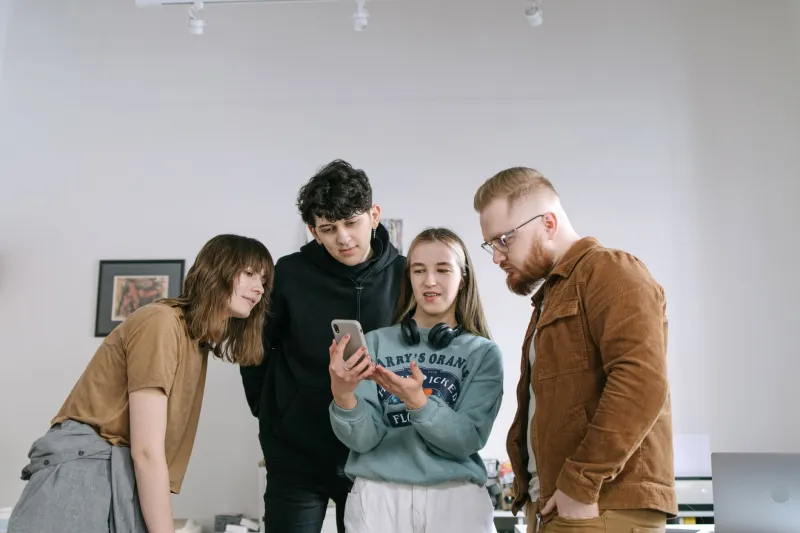
Picture this: You're at brunch with your four closest friends. Someone brings up a video that had them absolutely crying laughing at 2am. Blank stares. Nobody saw it. Then someone else references a creator who apparently said something wild last week — and again, half the table has no idea what they're talking about. You all pull out your phones to show each other things, and within about thirty seconds, it becomes obvious that you are not consuming the same internet. Like, at all.
It's not that anyone drifted. The group chat is still popping. The plans still get made. But the context — the shared cultural language that used to come from watching the same stuff, laughing at the same memes, getting outraged about the same drama — that's quietly fracturing. And the culprit isn't a falling out or a misread text. It's the algorithm, doing what it was built to do.
When the Feed Becomes a Filter Bubble You Didn't Ask For
Here's the thing about recommendation algorithms: they're genuinely good at their job. Too good, honestly. Platforms like TikTok, Instagram, and YouTube are designed to learn your preferences at a granular level — not just your broad interests, but your mood at 11pm versus your scroll habits on a Sunday morning. Over time, your feed stops looking anything like a neutral information stream and starts functioning more like a custom-built media universe shaped entirely around you.
That would be fine if you were a solo unit. But you're not. You exist inside relationships, and those relationships used to be held together partly by shared media. You and your friends grew up watching the same TV shows, quoting the same movies, reacting to the same news cycles. That common ground wasn't just entertainment — it was connective tissue.
Now, that connective tissue is getting quietly shredded by personalization engines that have zero interest in keeping your social circle culturally aligned. Your best friend's algorithm decided she loves slow-living content and cottagecore aesthetics. Yours decided you're deep in political commentary and indie music discourse. Your other friend is apparently spending all his screen time on gym culture and fantasy sports breakdowns. Nobody chose this divergence. It just happened, one autoplay at a time.
The Invisible Tension Nobody's Naming
What makes this especially tricky is that the friction it creates is hard to articulate. It's not like someone said something hurtful or canceled plans one too many times. It's more like a low hum of disconnection that shows up in subtle ways.
You make a reference and it lands flat. You try to explain a whole piece of online context and watch people's eyes glaze over. You feel a little embarrassed, then a little defensive, then weirdly lonely even though you're surrounded by people you love. The shared vocabulary just isn't there anymore, and filling in the blanks requires a level of explanation that kills the vibe.
Some friend groups are starting to notice this out loud. There's a version of the conversation that goes: "I feel like I don't know what you're into anymore." But more often, it just sits there unnamed — a vague sense that something is slightly off without any clear origin story.
Social psychologists have long pointed to shared cultural experiences as one of the building blocks of group cohesion. When those experiences stop overlapping, maintaining closeness requires more active effort. And in a culture that's already stretched thin between work, dating, family, and the general chaos of adult life, that extra effort doesn't always materialize.
Different Feeds, Different Realities — And Different Values?
Here's where it gets a little deeper. It's not just that your feeds are showing you different memes. In some cases, they're showing you different worldviews. Spend enough time in a particular algorithmic pocket and you start absorbing its assumptions, its language, its priorities. The fitness corner of TikTok has a whole philosophy attached to it. So does the personal finance side, the social justice lane, the tradwife aesthetic, the hustle culture grind content.
When friends are marinating in completely separate ideological microclimates online, it can start to surface in real-world conversation in ways that feel jarring. Suddenly someone says something that seems to come out of nowhere, but really it came out of three months of consuming a very specific corner of the internet that nobody else in the group has visited. It can create genuine misunderstandings — or worse, the slow accumulation of small moments where you think, "When did they start thinking like that?"
This isn't about pointing fingers or saying any particular corner of the internet is bad. It's about recognizing that the feeds we consume are actively shaping us, and when those feeds diverge hard enough, they can shape us in directions that create real distance between people who genuinely care about each other.
So What Do You Actually Do About It?
The honest answer is that there's no clean fix, because the algorithm isn't going anywhere. But there are ways to push back without throwing your phone into a lake.
One of the most underrated moves is just talking about your feeds with your friends the same way you'd talk about what you've been watching or reading. Not in a performative way — just casually sharing what's been pulling your attention lately. "I've been really into this creator who breaks down urban planning" or "I've been deep in a weird corner of BookTok" creates the kind of voluntary cross-pollination that the algorithm will never do on its own.
Group chats can also serve as a low-pressure bridge. Dropping a video or a post and saying "this has been all over my feed" opens a door for your friends to either recognize it or get curious about a world they haven't seen. It's a small thing, but it keeps the cultural overlap alive intentionally rather than leaving it to chance.
And sometimes it's worth just naming the dynamic directly. Saying "I feel like our feeds are completely different right now" is a disarmingly honest conversation starter that most people will actually appreciate. It reframes the disconnection as something external — a structural thing — rather than a personal failing.
The Feed Isn't the Friendship
At the end of the day, a friendship is more than a shared content diet. The algorithm can split your For You Pages into completely different dimensions and the relationship can still survive — even thrive — if there's enough intention behind it.
But it's worth paying attention to what's happening, because the digital fragmentation is real and it has real-world weight. The platforms will keep doing what they do. The question is whether your friend group decides to actively create common ground, or just lets the feeds do all the talking.
Spoiler: the feeds don't have your best interests at heart. Your friends, probably, do.